UKNF Supervisory Blog - Komisja Nadzoru Finansowego

COMMUNICATION
Blog: FinTech smog. Are small payment institutions technological start-ups?
Prepared by: Emil Radziszewski – Managing Director of the Banking Supervision Division at the UKNF
In early August 2026, the Government Legislation Centre published, on its website, a letter of Urząd Komisji Nadzoru Finansowego (UKNF) to the Ministry of Finance, in which the UKNF calls for considering the elimination of regulations on the establishment and activity of small payment institutions (MIPs) as part of the current work on the draft Act amending certain acts to develop the financial market and increase financial stability (UC132). The call is a result of almost 8 years of the UKNF’s experience in supervising MIPs and of a thorough analysis of this section of the financial market. Arguments raised by the UKNF in support of the proposed change are presented transparently and everybody can read them at legislacja.rcl.gov.pl. Besides, each interested person may independently verify the validity of the arguments, using publicly available sources of information.
Some voices publicly criticise the UKNF’s idea, pointing to the aspects related to financial innovativeness or to the need for maintaining conditions conducive to the creation and development of start-ups in the market of payment services. However, are MIPs actually FinTech firms that implement financial innovations? Are these really start-ups that look for opportunities for taking up a real activity in the financial market? Does the special regulatory sandbox created by legislation on MIPs truly implement the goals and objectives of regulators? Finally, would the further existence of such solutions mean only the acceptance for a higher level of risk in a narrow area of the financial market or would it generate more tolerance to phenomena that are unfavourable or even unacceptable, not to say pathological? We will answer those questions below.
According to the definition developed by the European Banking Authority (responsible for, among other things, regulations on payment services and their providers), FinTech means technologically enabled financial innovation (namely pioneering, innovative ways of providing financial services) that could result in new business models, applications, processes or products with an associated material effect on financial markets and institutions and the provision of financial services. The effect is to be material and positive, enhancing the potential and competitiveness of the market and its institutions, availability of financial services to users, speed of their provision, and their cost-efficiency. In the area of payment services in the Polish market, such financial innovations included undoubtedly:
- instant pay-by-link payments implemented already in mid-2000s;
- the BLIK payment system, operating since 2015;
- the DLT-based e-money standard implemented by the Polish company Billon Solutions, which in 2019 received from the KNF a licence as an e-money institution (the only one so far – not because other applications were rejected but because there were none);
- fast transfer of funds between payment card accounts (card-to-card payments) implemented by Fenige (whose licence as a domestic payment institution the KNF was unfortunately forced recently to withdraw, but this decision had nothing to do with the innovativeness of services provided).
Key FinTech development tools provided by the public party (according to the EBA definitions) are:
- regulatory sandboxes – solutions providing financial institutions and non-financial firms with controlled space where, supported by the supervision authority and for a limited time, they can test FinTech solutions by verifying and checking in practice a business model in a safe environment;
- innovation hubs – institutional solutions as part of which regulated or non-regulated entities contact the competent authority (usually responsible for financial supervision) to discuss FinTech-related issues (share information and views, etc.) and seek clarification on the conformity of business models with the regulatory framework and/or licensing requirements through individual guidance on the interpretation of applicable rules.
Both tools have been implemented in Poland, but the sort of regulatory sandbox understood as a regulatory environment that allows for carrying out real activities to a limited extent has been introduced specifically for MIPs. It is worth noting that the solution does not entirely reflect the model described by the EBA. It does not require any testing of FinTech solutions and it does not provide for temporary limitation of activity. It is also hard to say that authorising the provision of services to real clients means creating a safe testing environment. In 2020, the UKNF also introduced a virtual regulatory sandbox programme which allows for, among other things, testing selected payment services in an environment isolated from the market. So far, the programme has not attracted particular attention, though.
Since 2018, the UKNF has been running the Innovation Hub programme, under which consultations for 244 applications were carried out by the end of 2025. Of all applications fully admitted to the programme, 50 applications were related to the payment service market, and only 6 came from entities that applied for registration as a small payment institution. Only 3 of those entities exist to this date.
Additionally, in accordance with Article 11b of the Act on financial market supervision, entities intending to pursue activities supervised by the KNF in the area of products and services aimed at developing the innovativeness of the financial market may receive from the KNF an official interpretation of the scope and manner of applying the rules governing such activities. To this date we have received 107 applications for such interpretation, and 47 of them have been classified as related to financial innovation. Of 47 applications, only 18 were related to the market of payment services, while in 10 cases the declared innovativeness was supposed, first and foremost, to justify the exclusion of application of the Act on payment services. Only 4 entities requesting interpretation regarding financial innovation applied for registration as a small payment institution (two in 2018, one in 2019, and one in 2023). Only 2 of them exist to this date.
An entity applying for registration as a small payment institution is required to submit an application accompanied, among other things, by the following supporting documents:
- a list of payment services the entity intends to provide, together with a presentation of such services in the form of a diagram and a description of such services and their classification by type of payment service as defined in the act;
- a programme of activities and a financial plan for the period of the first 12 months of the activity.
Leaving aside the generic nature of those documents, which is often witnessed, especially in recent years, their analysis makes it possible to state that in the 8-year practice of applying those rules and after processing 331 applications for registration as a small payment institution, only 10 cases may be considered an attempt to test or implement innovative solutions.
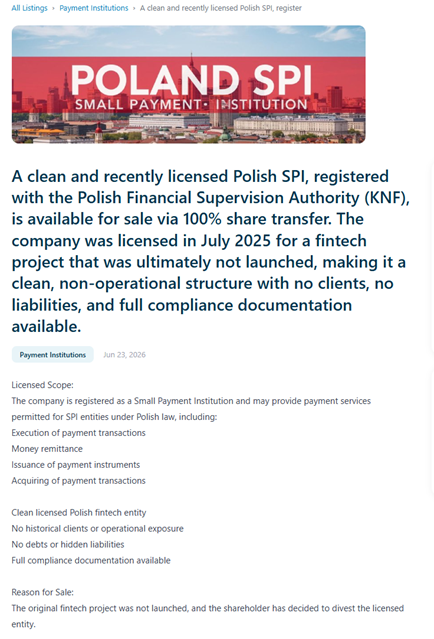
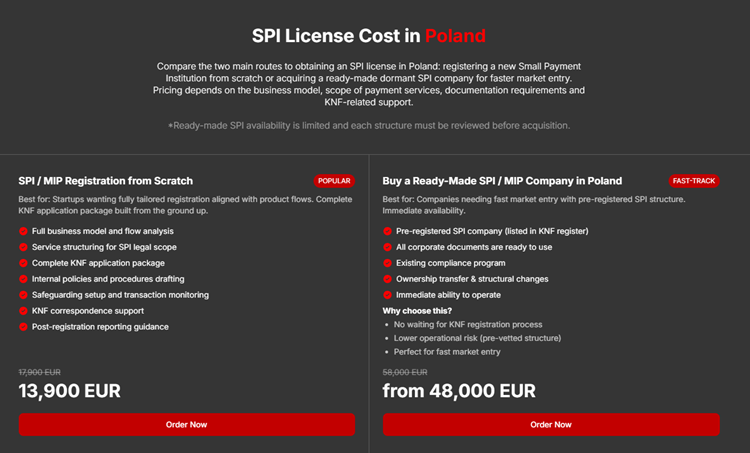
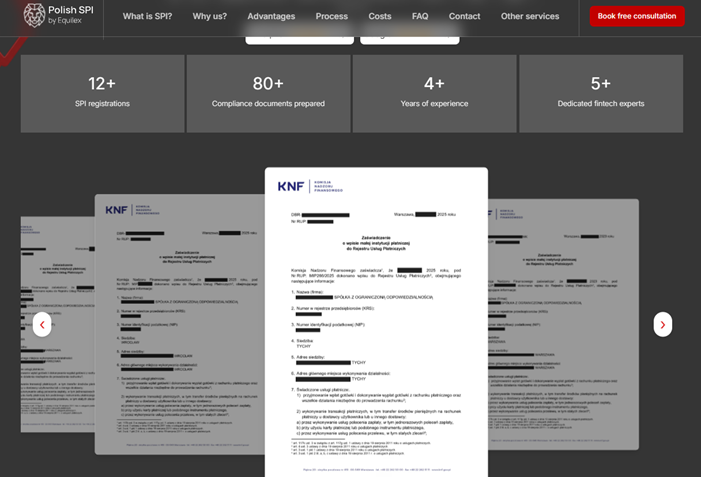
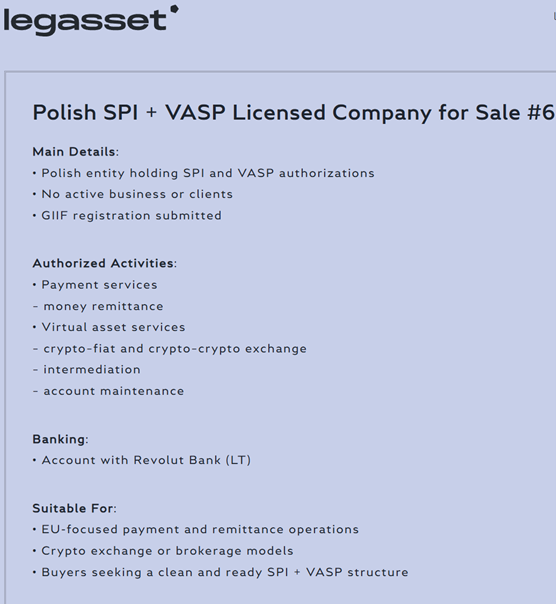
Also the start-up nature of MIPs is a myth. Of 291 MIPs registered so far, 50 were deregistered ex officio due to their inactivity for a period longer than 12 months. Of 168 MIPs active in the end of 2025, as many as 60 reported to the KNF the execution of up to 36 payment transactions throughout the year, and as many as 53 entities executed less than 10 payment transactions. The analysis of the nature of those transactions shows that the stated figures are not a result of low demand for services provided by such MIPs but rather of those services being executed only within the family&friends model. This brings us to another observation related to MIPs.
A large part of applications for registration as a small payment institution is of standardised and generic nature. The monitoring of further fate of MIPs so registered shows that those are shelf entities, created only for the purpose of being sold to random purchasers. There is even a trading market for MIPs, and the screenshots presented below speak for themselves.
The views expressed in articles published on the UKNF Supervisory Blog are the personal views of their authors and do not represent the official positions of the Polish Financial Supervision Authority or the Office of the Polish Financial Supervision Authority.