Multimedia - Komisja Nadzoru Finansowego

COMMUNICATION
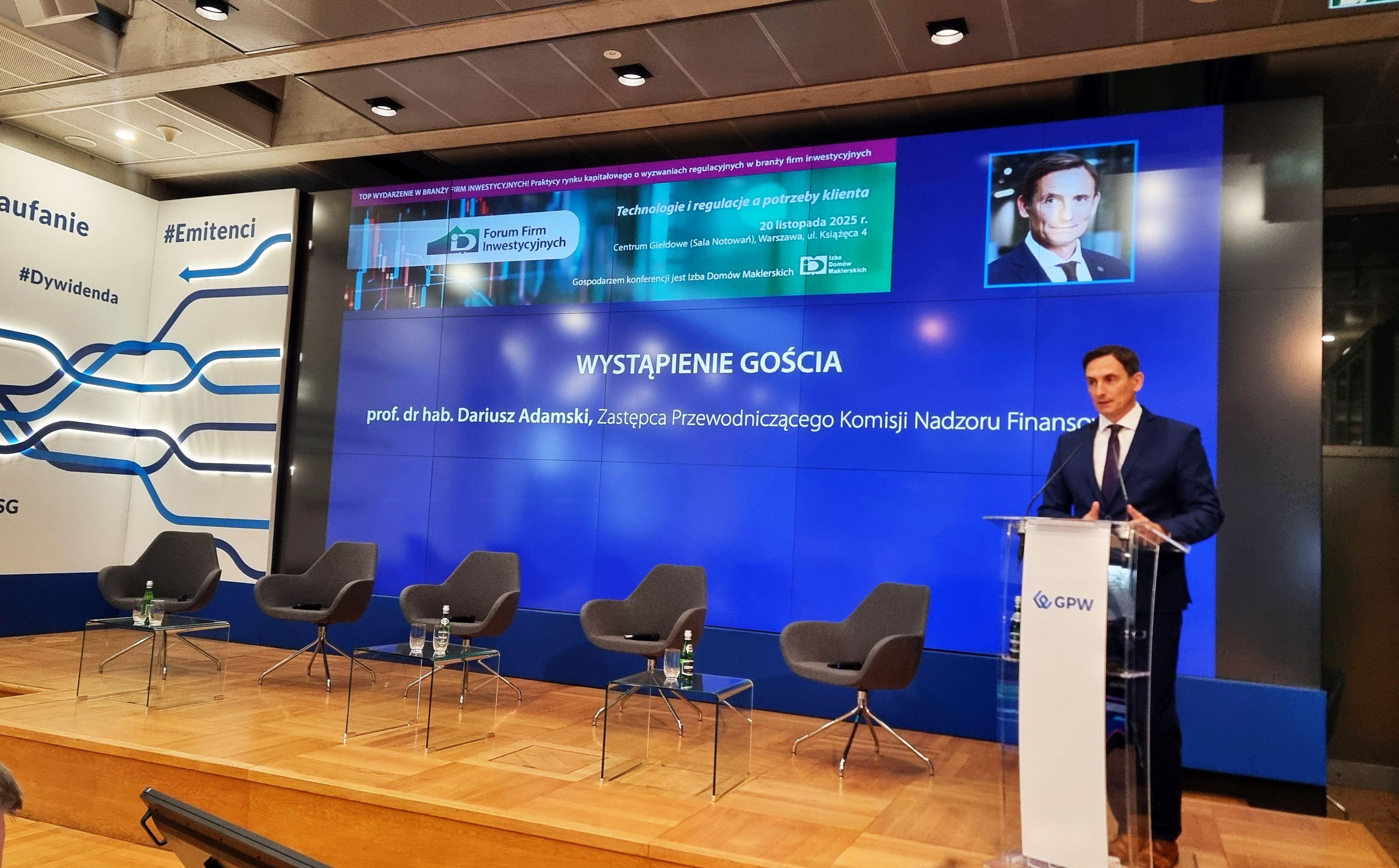
Dariusz Adamski, Deputy Chair of the KNF, spoke at IDM Investment Firms Forum
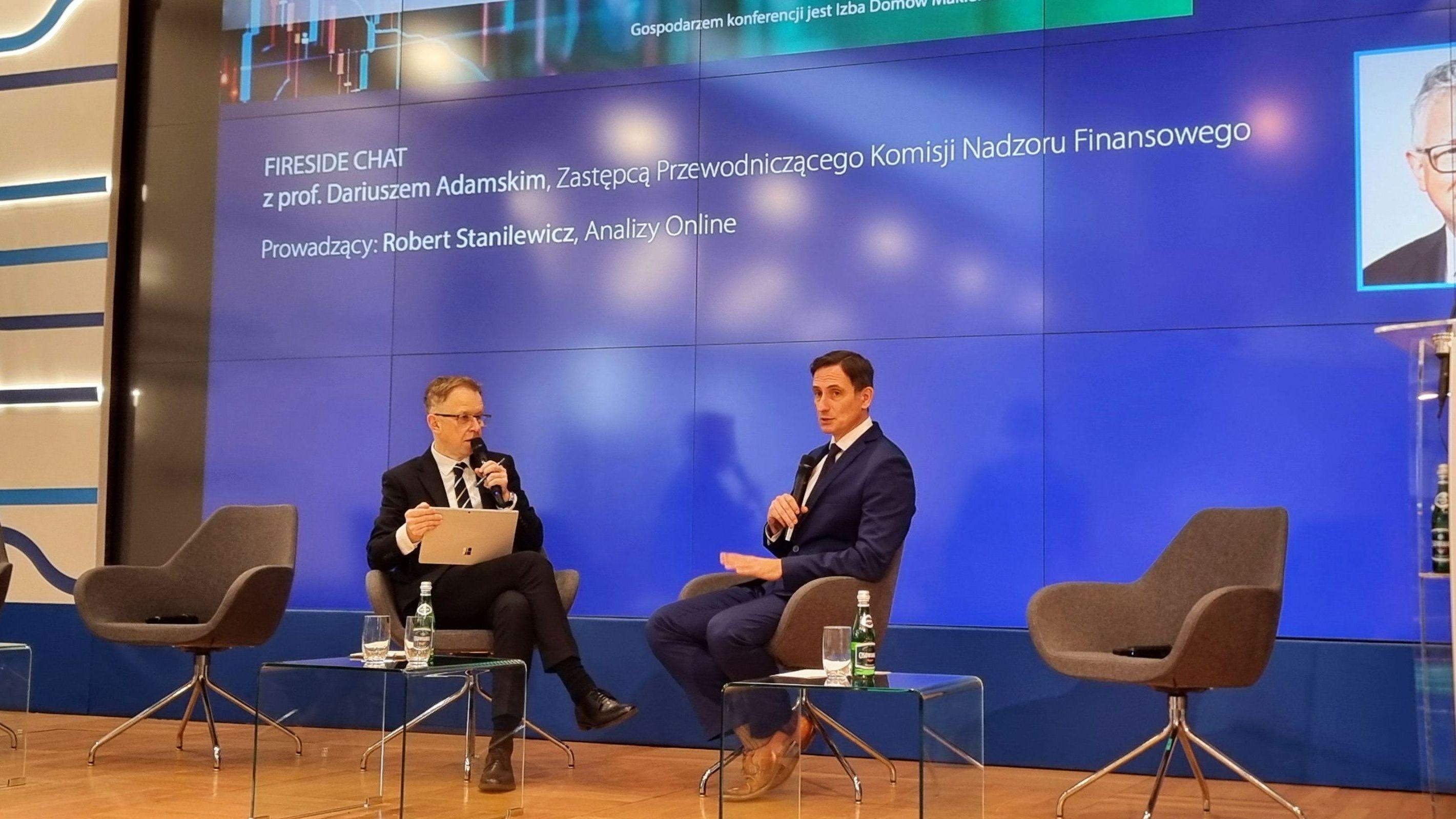
Dariusz Adamski, Deputy Chair of the KNF, spoke during the opening of 2025 Investment Firms Forum, held by the Chamber of Brokerage Houses (Polish: Izba Domów Maklerskich – IDM). He also took part in a fireside chat, where he answered questions asked by Robert Stanilewicz (Analizy Online).
Dariusz Adamski’s speech focused on supervisory priorities of the KNF in the area of the capital market, the role of retail investors, and the future of investment firms in regulatory and technological contexts.
The Deputy Chair of the KNF has stressed that the most important goal for the UKNF for the upcoming year is to support the development of long-term saving products. This is due to the observation that retail investors who act with a short-term horizon in mind often make suboptimal decisions. Long-term products, in particular pension products, such as employee capital plans (PPK) or individual retirement security accounts (IKZE), stabilise investors’ conduct and support the economy systemically. They also have great significance for demographic changes. The Deputy Chair of the KNF has already initiated dialogue with the market on actions necessary to develop other long-term saving instruments, in particular ELTIFs.
Dariusz Adamski has stressed that competitiveness means ability to compete also with foreign markets. The supervision authority declares it promotes competitiveness, and thus accepts that entities that are less fit and unable to adapt and develop should be ‘pushed out’ of the market. A market without anyone who loses is unable to grow.
The Deputy Chair of the KNF has also referred to adequacy tests, namely requirements regarding client onboarding, which is a matter of great interest to the market. The current approach fails to properly differentiate between complex and non-complex products. The UKNF plans to reduce the requirements related to non-complex products, such as shares, bonds or standard funds. At the same time, it intends to ensure stronger enforcement of requirements related to identification of target groups and adequacy tests for complex products in the case of which retail investors often lose money. The implementation of the two-track system may require changes in companies’ IT systems. The supervisor, however, does not intend to force these changes but rather to leave the decision to the companies: they may either simplify their onboarding process for non-complex instruments, or they may keep their current processes that possibly discourage clients from investments.
Dariusz Adamski has also declared there will be greater flexibility and swiftness, and at the same time, greater predictability of UKNF decisions. Simultaneously, he encourages the market to report areas that require clarification or simplification, in particular in the context of reporting or new services, so that the supervisor can react where truly necessary.
The Deputy Chair of the KNF emphasised that so far in Poland investment firms had not managed to build lasting relationships with clients. Technological progress favours quick “monetisation” of relationships instead of building long-term cooperation with clients. This does not foster development of investment firms, which is why the UKNF sees room for enhancing investment advice and portfolio management services, and is willing to join actions that will support that. It also sees room for improving competences of people who support investment firms’ clients, in particular so-called authorised employees.
He announced the cooperation of the UKNF with the market in the area of the tokenisation of financial instruments and the use of blockchain to reduce the cost of transactions. He added that the planned organisational changes at the UKNF aimed at intensifying the activity of the UKNF in the area of using new technologies, in particular in the capital market.
He declared the readiness of the UKNF to reduce unnecessary reporting obligations, intervene where regulations hamper development (e.g. the issue of VAT in distribution services) and consult the market on a regular basis. He also emphasised that the UKNF would not make guesses on the woes of the market; it needs clear signals indicating what hampers the market’s development, and what potential solutions the market comes up at the with.