Multimedia - Komisja Nadzoru Finansowego

COMMUNICATION
Representatives of the UKNF attended the 14th Bancassurance Congress
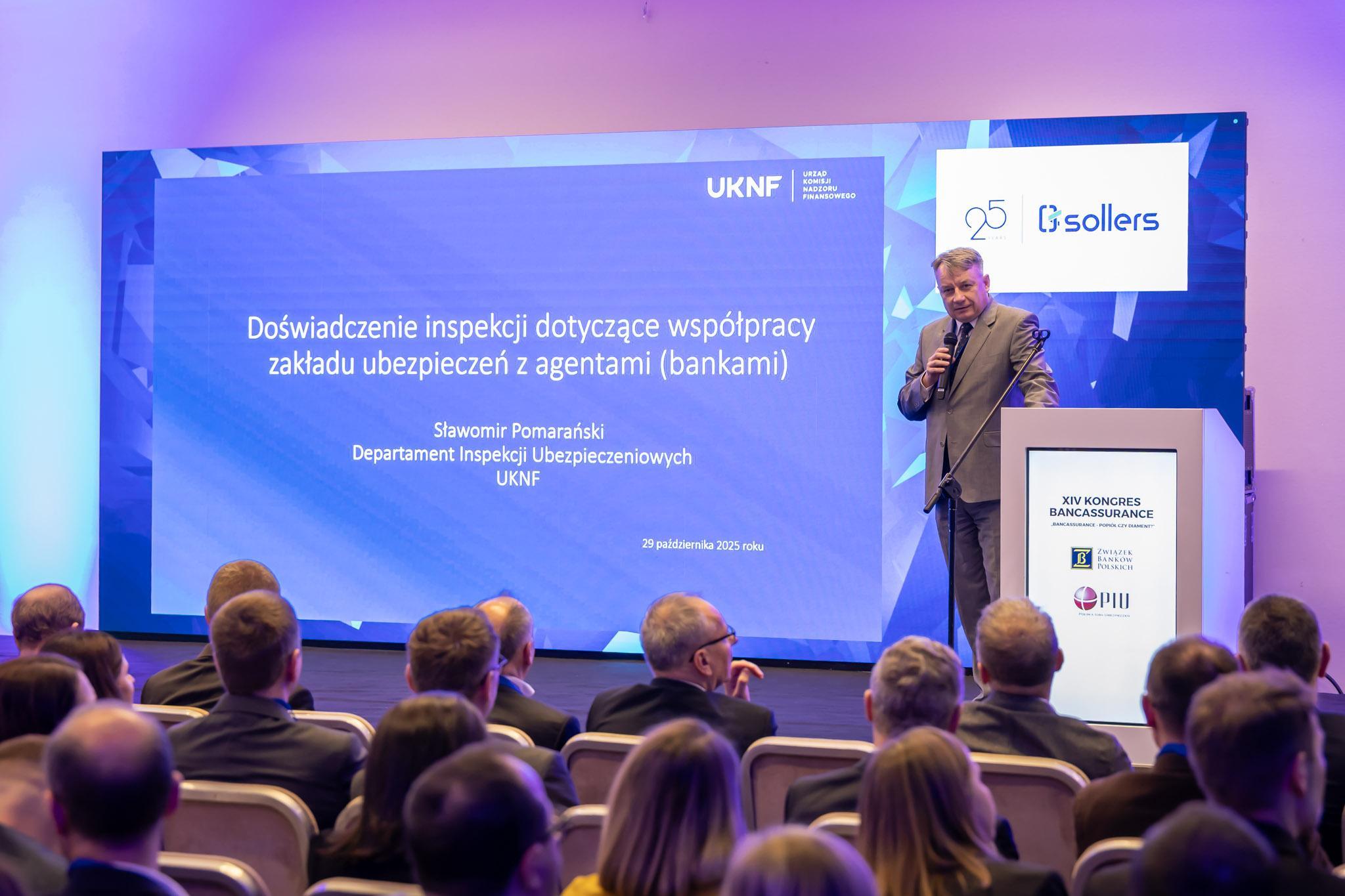
Sławomir Pomarański, the acting director of the Department of Insurance Inspection, and Maciej Podlewski, Director of the Insurance Governance and Distribution Supervision Department, took part in the 14th Bancassurance Congress. The event was organised by the Polish Bank Association (ZBP) and the Polish Chamber of Insurance (PIU).
Sławomir Pomarański gave a speech on ‘Findings from UKNF inspections in the area of bancassurance and the approach to verifying the implementation of Recommendation U amendment’.
At the outset, he emphasised the constant need to deepen and refine the process of analysing customer needs and requirements in relation to insurance contracts offered. He mentioned examples that required adjustment and those that should be eliminated from the market.
He recalled the ‘product intervention measure’ in force since 2021 – a decision of the KNF concerning the elimination of insurance products that bring no additional value to customers. He referred to the results of the verification of how insurance undertakings had implemented the decision. As he said: ‘in some institutions, insufficient verification of product implementation was identified, in particular in the area of life insurance for the elderly. Additionally, in some cases, insurance undertakings were not able to prove that they had met the 50% requirement in stress tests for one-off and regular premiums.’
At the end, he referred to Recommendation U, which aims to raise bancassurance standards. As he said: ‘The Recommendation covers significant elements of banking and insurance activities, and for this reason, it should be analysed from the perspective of banking and insurance supervision.’ In the context of banking supervision, the purpose of Recommendation U is to improve standards in banking activity and raise awareness of risks in the area of bancassurance, while ensuring appropriate value to the client in the insurance contracts offered.
He shared his observations that inspections had shown general improvement in the quality of insurance products, achieved through the adjustment of products offered by adding new features, such as an earlier payout or an extended scope of coverage. He added a caveat, though, that ‘there is a need for an in-depth analysis of the structure of compensation in the process of verifying Recommendation 20, in order to ensure full compliance of rules concerning the establishment of customer value.’
Maciej Podlewski spoke at the panel titled ‘Where is room for growth?’.
Panel participants reflected on the current standing of the bancassurance market. ‘We do not see spectacular growth in the bancassurance segment today, but that does not mean that it lacks potential; there is potential, but what is needed is adaptation to the regulatory reality and to clients’ needs,’ Maciej Podlewski said.
When talking about products sold in the bancassurance channel, one cannot limit oneself to the slogan of ‘value for the client’, assessed through the prism of the minimum loss ratio. It is an important element but not the only one as the quality of sales, after-sale services, and the claim adjustment process are equally important. ‘Only such a holistic approach builds confidence and a stable relationship with a client,’ Maciej Podlewski emphasised.
Do recommendations merely limit risks, or do they also foster innovation?
The discussion has shown that the recommendations of the supervision authority, such as Recommendation U, were introduced, from time to time, in response to irregularities identified. ‘In many cases, products were replaced and the offer was adjusted,’ Maciej Podlewski said.
When referring to the matter of risks and opportunities related to sale through online channels, Maciej Podlewski emphasised that new distribution channels, such as applications or online services, undoubtedly represent an important direction for the development of bancassurance as they allow outreach to younger, digitally active clients, but they also entail risks related to, among others, the need to ensure regulatory compliance, particularly regarding access to clients’ data. On top of that, the society is ageing; clients aged 60 and over still need insurance products, but they do not always use digital channels and they will most preferably rely on bank advisors. ‘It is therefore necessary to strike a balance in sales channels; technology should support human contact rather than replace it,’ Maciej Podlewski said.