Multimedia - Komisja Nadzoru Finansowego

COMMUNICATION
Representatives of the UKNF took part in the Compliance conference organised by the Chamber of Brokerage Houses
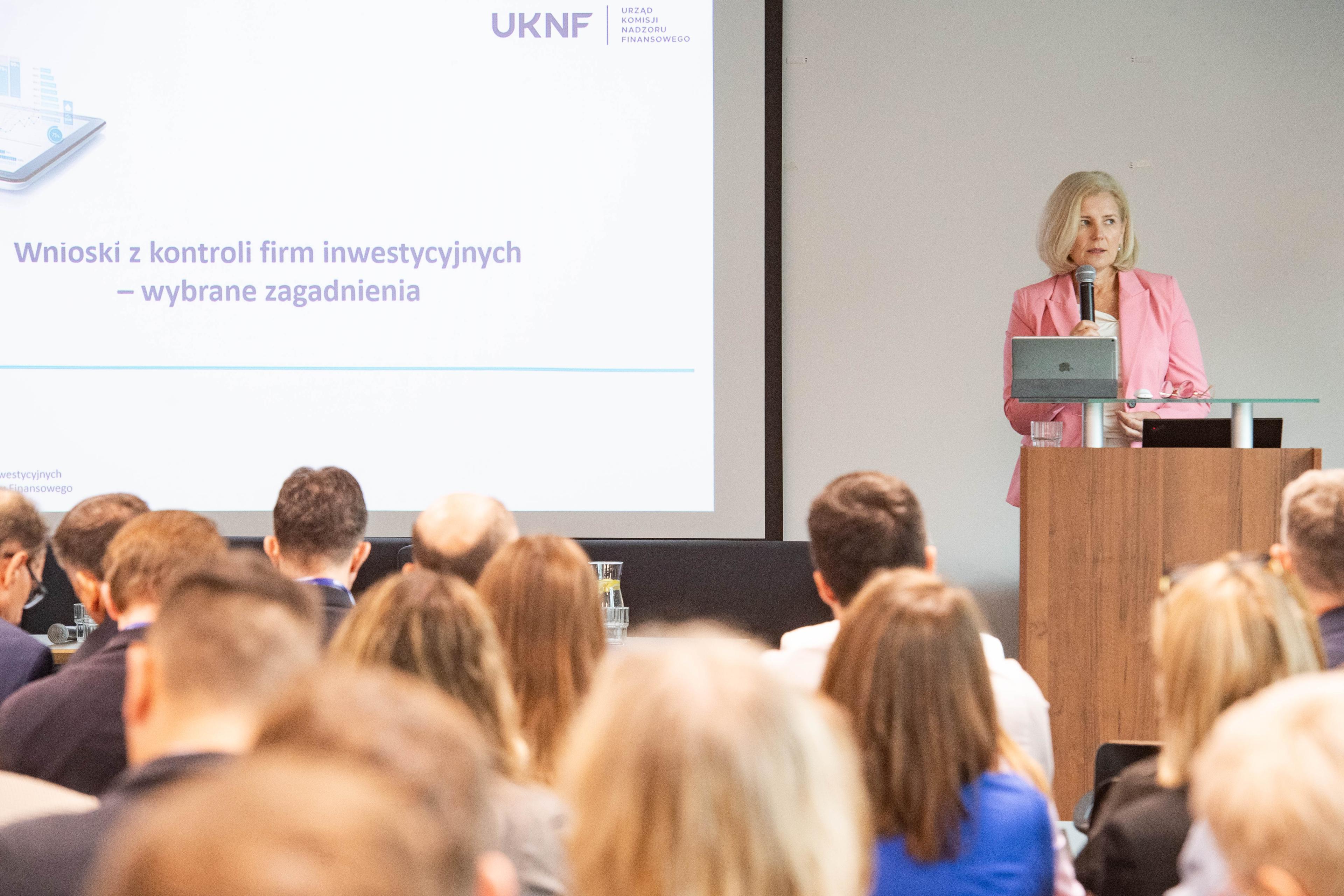
Agata Gawin, Director of the Investment Firms Department, delivered an opening speech on ‘Simplifications in regulations on investment firms’.
She indicated that there were areas where it was not necessary to change the law and simplification was in our hands as it was enough to make an informed decision and what was needed was not legislative changes but understanding that pursing the business of brokerage services involved risk both for clients and for firms. It is impossible to transfer that risk exclusively to clients.
Simplification may be understood as the streamlining of certain processes, including sales processes. It is worth asking if investment advisory services are not the simplest and the least risky form of sales. It allows avoiding unauthorised advisory services, often forced by clients, who are helpless when faced with the number of products offered. Selling through advisory services is also a form of education as it allows for introducing a client into the world of investments gradually by proposing subsequent products in an informed and responsible manner.
One of the areas discussed in the context of simplification in the EU is the integration of supervision. It is necessary due to the risks related to firms' cross-border business activity. Actions in this regard are needed because leaving supervision in the home country, when a firm pursues its business mainly in host countries, contributes to the sense of impunity among many firms. The integration of supervision, meaning clear rules, such as the licensing of such firms, mandatory verification of documentation, detailed assessment of the ability to act fairly, and performance of inspection obligations over that business, may contribute to building trust in the financial market across the EU.
Proposals on the transparency of supervisory activities, on-going communication, arrangements on the interpretation of laws and market practices that have been raised when supervised entities have reported their needs are implemented within the remit of the Investment Firms Department.
It is not the aim of the supervisory authority to impose financial sanctions or to hamper the business activity of entities. Our aim is to ensure proper functioning of the financial market and its stability, build trust and, first and foremost, protect clients.
At the end, Agata Gawin emphasised that simplification aimed to stimulate the market, boost competitiveness of the European economy and increase the level of investments. It is more oriented towards facilitating processes for business undertakings and motivating them to grow and to reach for capital. Its aim is also to increase the level of funds allocated for investments, in particular to reasonably secure retirement needs. Simplification processes do not mean, however, reducing the protection of investors; excessive and repeated requirements may be modified.
Dorota Nowalińska, Deputy Director of the Investment Firms Department, gave a speech on ‘Post-inspection findings of the UKNF’s Department of Investment Firms’. In her speech, she pointed to certain aspects that require further work:
- Information disclosure obligations related to investment advisory services require further improvement
Investment advisory services, in particular in the form of so-called portfolio advisory services, are increasingly more frequent and they are increasingly better but certain issues are still being identified in terms of providing information to clients. Failure to explain to the client correctly to what extent specific recommendations are appropriate to them in the context of their personal circumstances or objectives and failure to provide information on, or justification for recommending, a financial instrument not intended for a target group to which the client belongs may lead to legal and reputational consequences. - Affiliate influencers, including finfluencers, represent a new interesting form of cooperation, and at the same time, a supervisory challenge for investment firms
The growing popularity of cooperation with affiliate influencers in the area of promoting the brand or services of investment firms is also of important educational value when social media are used and various audiences are reached with such information. Even though laws allow for such general information activities targeted at a wide audience, in practice affiliate influencers get into direct contact with investors, which may be treated as pursuing agency activities without required licences. - Best Execution
The best execution exercise in respect of executing the client’s order in the Forex market involves both the examination of price fairness, including all elements of quoting and costs, as well as informing about trusted venues of execution (sources of liquidity). We take the best execution exercise into consideration also as a tool for managing the conflict of interest between the investment firm and the client (e.g. liquidity fees incurred by the investment firm and the costs for the client). ‘Ensuring business continuity by investment firms in the process of executing the order is also treated by us as an element of “best execution”,’ Dorota Nowalińska emphasised.
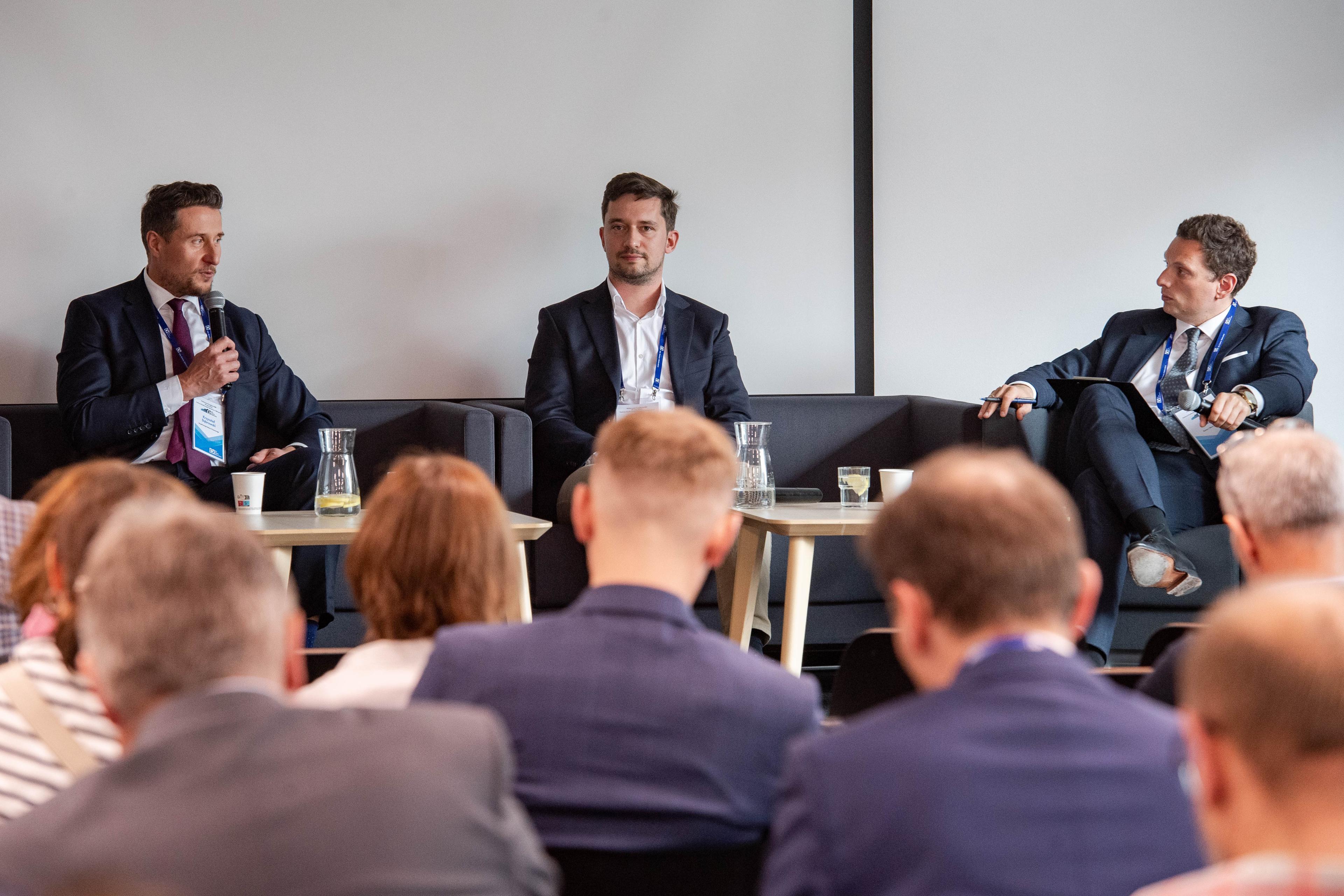
Krzysztof Dąbrowski, Managing Director of the Security Division, spoke on the panel titled ‘Best practices and challenges in the implementation of DORA’.
Key points of Krzysztof Dąbrowski’s contribution:
Many doubts regarding interpretation are repeated, which shows that certain areas of DORA create difficulties irrespective of the type of institution. We conduct an institutional dialogue as there are numerous questions related to DORA. Even though some of them have been clarified, the new ones are still popping up. Also the fact that some implementing acts have not been published yet does not help.
Differences in the approach to the implementation of DORA can be witnessed already at this point, even through the prism of activity of certain entities. The bigger ones, with more complex structures, often started analysing gaps between DORA requirements and the actual status quo earlier. This stemmed from their scale, complexity of business processes, and – naturally – resources.
The implementation of DORA should have been completed by 17January, namely within two years of publication. ‘Still, a dialogue between financial entities and supervisory authorities at the national and European level is pending and the provided answers on interpretative doubts allow for potential optimisation and adjustment of adopted measures,’ Krzysztof Dąbrowski emphasised.
Elżbieta Lech, Manager of the Regulatory Supervision Team at the Investment Firms Department, spoke on the panel titled ‘Deregulating the capital market while protecting investors’.
Key points of Elżbieta Lech’s contribution:
Regulations on the capital market are actually a full transposition of EU regulations. Similarly as the regulations themselves, their interpretation is shaped predominantly at the EU level by the European Commission or ESMA through guidelines and Q&A.
Guidelines or statements preceded with market consultations are a good method for eliminating certain practical doubts that market players have at the stage of implementing those measures in their organisations.
‘Dialogue between you and us is the best method to reach a compromise,’ Ela Lech stated. ‘This is why you are invited to be a part of this dialogue within consultations on legislative acts, not only at the national level, but also at the EU level – as part of the ‘call for evidence’ exercise. Your involvement may shape certain measures or result in their discarding.’