Multimedia - Komisja Nadzoru Finansowego

COMMUNICATION
Jacek Jastrzębski spoke about crypto-currencies during the debate of CEOs at the Conference of the Chamber of Brokerage Houses
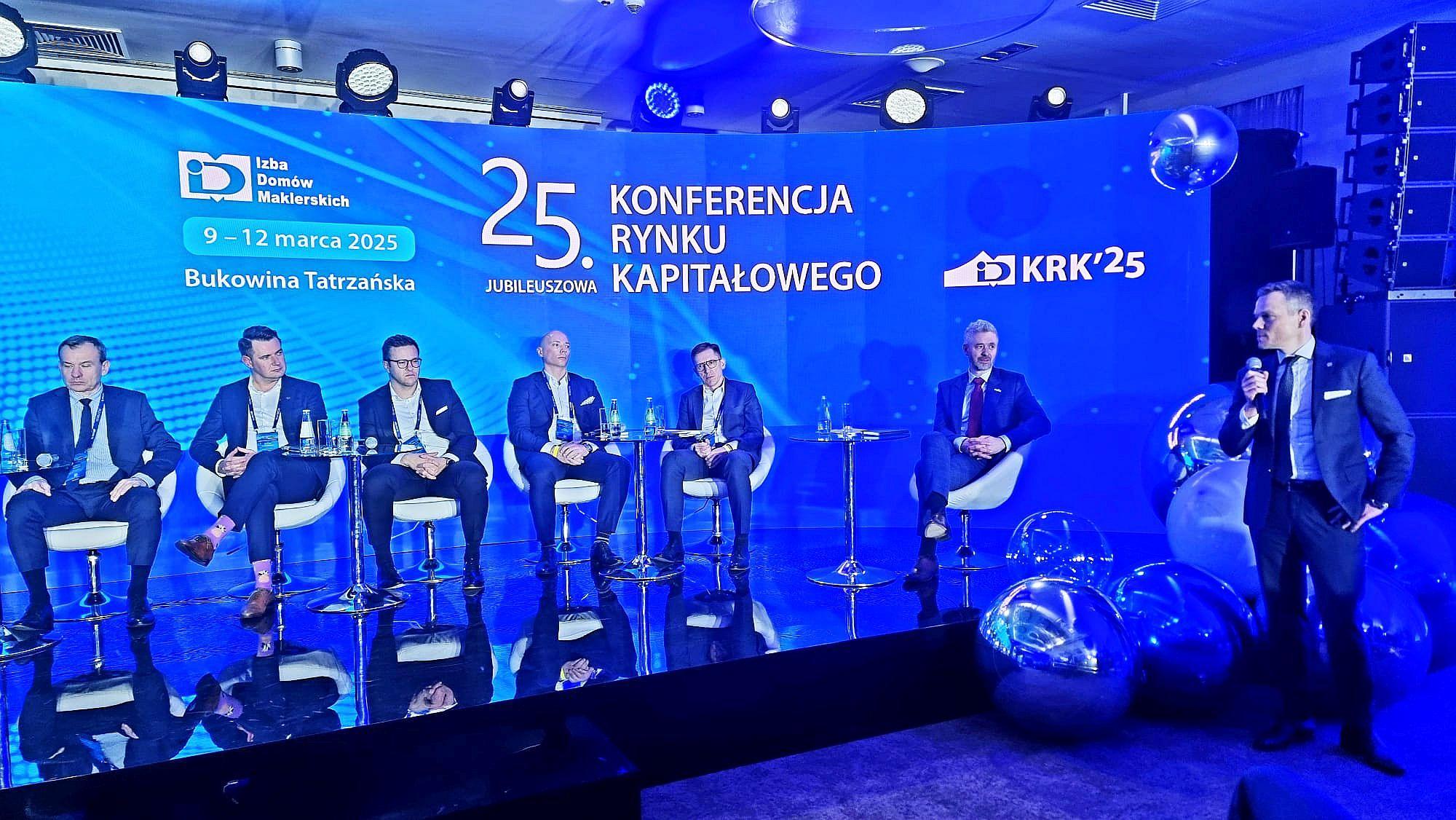
Jacek Jastrzębski, Chair of the KNF Board, closed the debate of heads of investment companies entitled ‘Opportunities and challenges of investment companies – how to attract investors?’, at the jubilee 25th Capital Market Conference of the Chamber of Brokerage Houses (IDM), held in Bukowina Tatrzańska. An impulse for the contribution of the Chair of the KNF was a topic of crypto-currencies raised during the debate and the discussion on whether investment companies should offer crypto-currencies to their customers.
Key points of Jacek Jastrzębski’s contribution:
- What we could hear during the discussion was the exact reason why we are sceptical towards crypto-currencies. I will ask a philosophical question: why certain institutions, such as banks, investment firms or investment fund management companies are endowed with the status of an entity of public trust granted to them by the legislator? What is the purpose of it? My understanding is that the state recognises the advantages of financial intermediation, namely it sees an advantage in the functioning of professional entities in the market which convert savings into lending activities or investments. The functioning of this mechanism requires institutional trust that the state grants to such entities through appropriate legislative actions and, ultimately, this endowment of trust happens via the supervisory authority within the licensing process. And here comes the question: do institutions that enjoy higher credibility endowed to them by the state with the intention of transforming savings into investments should use this privilege by being an intermediary in the pursuit of other goals.
- The discussions during the debate show that investors want to have, for instance, Bitcoin exposure, but at the same time the preferred channel for that exposure is the one offered by an entity of public trust. Investors want to purchase risky, speculative assets, but at the same time they expect an enhanced credibility channel guaranteed, to some extent, by the state. I am afraid that given the experience of our financial market, in the stress conditions scenario this may lead to a situation in which, if at some point it turns out that the value of such assets does not go up but plummets, we will have a discussion on whether the font size on onboarding documents is large enough, whether all statements and appendices have been signed by the customer and whether the customer has actually understood that Bitcoin is Bitcoin and not any other financial instrument. What I am talking about is in line with what I have said earlier about deregulation and risk-taking, because everything boils down to the model of gaining profit without taking risk. I am afraid that this may be a thinking pattern: as long as the value of a crypto-currency goes up, we think we make bold investment decisions, but when it goes down, then this is misselling. We have already seen it in the financial market and this is our concern, hence our scepticism.
- In my opinion, the interest in crypto-currencies, in particular Bitcoin, is partially the result of the ‘social-mediatisation’ of life. We all would like to believe in images that are presented to us on social media: that you can earn a lot without learning and working. We are maybe a little bit older than the target group of that message and this is why we are more sceptical. But undoubtedly, you are now facing a group of customers who enter the market and are shaped by that message.
- I am also strongly sceptical when I hear from institutions of public trust, such as banks or investment firms, the following line of reasoning: ‘We need to offer our customers access to Bitcoin through our channel because our customers want it. Besides, if we do not offer it, somebody else will.’ The financial market has seen some products that customers also wanted very much, and now the effects have materialised in the form of billions in write-offs and provisions in the banking sector. These were also the products that customers wanted. And financial institutions argued similarly that if a specific institution did not offer the product, the customer would get it elsewhere.
- I can imagine a lot of products that customers want, but for some reason, access to them is rationed by the state. I do not want to give you any specific examples but everyone can think of one. One way or another, the argument that customers want something as a justification of those products being offered by institutions of public trust is debatable for me personally, in particular if the argument is raised by those entities themselves.
- I am not saying that the purchase of crypto-currencies should be forbidden. Maybe this is a symptom of freedom to decide on one’s own assets. Maybe this should not be restricted in any specific manner. What we fear, however, and what is illustrated by this discussion, is the scenario in which if customers are exposed to crypto-currencies through the services of an entity supervised by the KNF, it will be fine as long as their value goes up, but when it plummets, it is you who will be on the hook. And if it happens that the entity who acted as an intermediary is not solvent enough, it will be the state who will be on the hook. Someone will come to us and say: you were the one who supervised this brokerage house.
- I am afraid that the path of regulation and supervision over the crypto-asset market that is justified by striving for protecting the buyers of such assets and involves allowing those instruments to enter the regulated and supervised channel would result in essence in the providers of services related to such assets obtaining tools to promote them and a distribution channel that enjoys enhanced trust. As a result, we start promoting this. The regulated and supervised channel of distribution exists to promote savings and conversion of savings into investments, not to promote the satisfaction of other needs.
- For this reason, as I said, I am not telling that crypto-assets should be prohibited but I think that the privilege of being an institution of public trust endowed by the state due to the special value that lies in the functioning of the financial market and the fundamental role of trust for the functioning of that market should not be used as a tool aimed at promoting the possibility of investing in crypto-currencies. Maybe this is a conservative approach but in my opinion it is logical and reasoned. I am glad that I have heard similar voices from representatives of the market.
- I want to emphasise that I have been talking about crypto-currencies. I am not talking about everything that is related to the use of Blockchain for the purpose of streamlining and increasing security of transfers or clearing. We support all of that. Nor does my sceptical approach extend to otherwise economically reasonable actions that consist in the tokenisation of certain classes of assets. Nonetheless, as for the fascination with crypto-currencies and letting them enter the regulated channel on the ground that this is what customers expect, I believe this is exactly your responsibility to not always follow what customers expect at a given moment in time.